
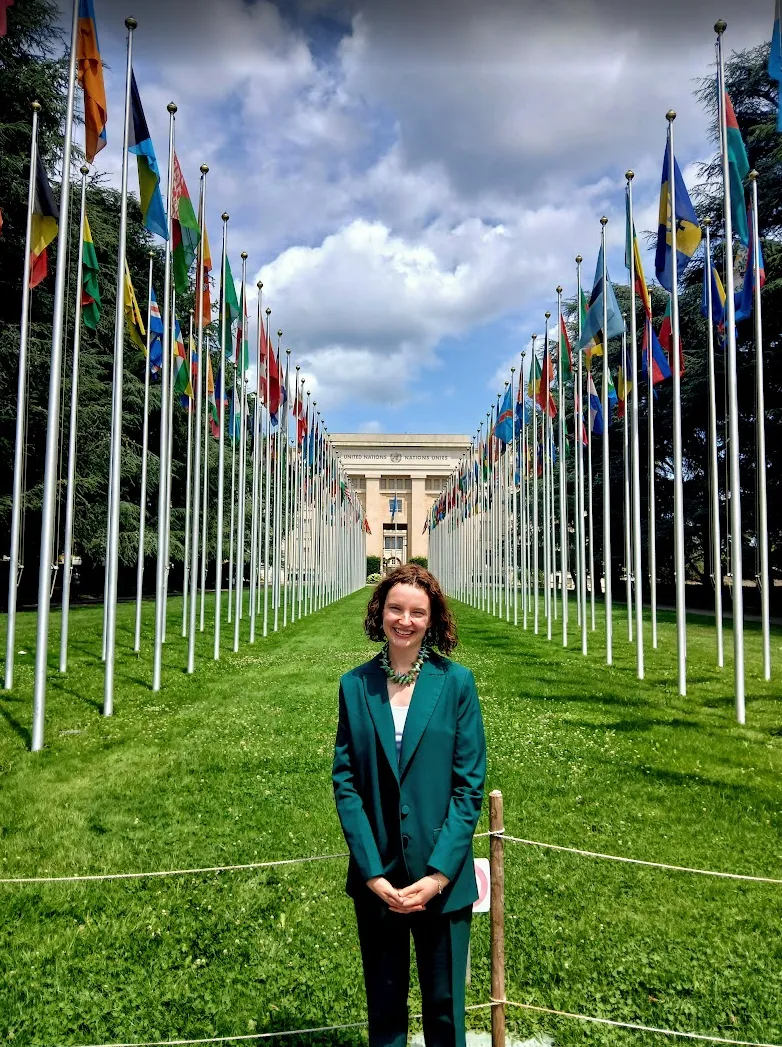
When Trinity Shires packed her suitcase for her first overseas trip, she expected an adventure. What she didn’t expect was to be walking through the imposing halls of the United Nations in Geneva, wearing an official lanyard and taking her seat among hundreds of delegates from around the world.
For two weeks, Trinity had the privilege of representing the University of Tasmania and the National Aboriginal and Torres Strait Islander Education Consortium at the Expert Mechanism on the Rights of Indigenous Peoples, a global forum bringing together Indigenous voices from across the globe.
“It was incredible,” Trinity says. “Walking through the UN buildings, seeing lawyers, politicians and ambassadors. We got to meet the Ambassador for First Nations People, Justin Mohammed and tour the Australian consulate.”
Trinity was one of just two students selected to attend the fully funded trip after the University of Tasmania put out a call to indigenous students asking: “If you got to speak at UN what would you speak about?”
In her application Trinity shared a concern close to her heart – the conservation of mutton birds and the impact of wind farm developments on sacred land.
This became the topic for her written intervention that was submitted to the Secretary of the UN during the forum.
Trinity’s Intervention
“A rising issue for Indigenous people in Tasmania is the construction of the largest wind farm in the southern hemisphere on Robbins Island, which could cause substantial fauna biodiversity problems,” Trinity says.
“Robbins Island was and is a place of great cultural significance.
“The impact of wind farms could mean the loss of the mutton bird species, the loss of a traditional food and an Indigenous income source. It would be a significant cultural loss.
“It is about right to self-determination. The right to address the issues if someone were to use the land and the right to prevent issues from happening.”
Submission to the UN Secretary
After interventions were submitted to the UN Secretary, speakers were selected at random to present in front of hundreds of delegates. Trinity was not called on, but her fellow UTAS representative, Alieta was.
“There were about 200 to 300 people in the room,” Trinity recalls. “Everyone sat in front of a microphone. If you were selected, your face appeared on a huge screen at the front of the room. You had two minutes to speak before your microphone switched off.”
“We all wore earpieces with live translation. Tourists walked behind the glass windows taking photos, which was a bit strange.”
Meeting Global Indigenous Communities
Trinity describes the whole experience as “full on, but very worth it.”
“It was incredible meeting so many people from all over the world, Sami and Inuit people, and Indigenous communities from Brazil and Malaysia.”
“It was nice and also sad hearing people’s stories and all the issues we’re facing. There is so much that goes unnoticed, especially in Africa. Some of the people we met with couldn’t go back to their country because of their activism.”
Building Connections
Trinity valued connecting with other young people and meeting participants from across Australia, including people from The Uluru Statement From the Heart.
“It was a great opportunity to learn from each other,” she says.
“It was very eye opening to see what has been done, but how much more that needs to be done.”
Since returning to Jane College, Trinity is inspired to travel further, keen to learn from other cultures and bring those perspectives back to her community.